

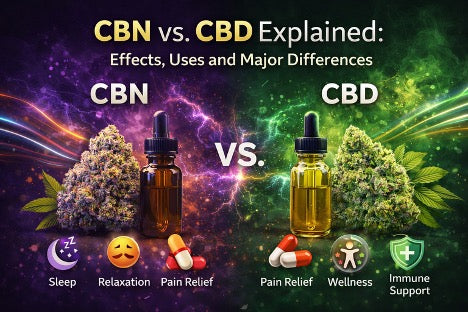
Key Takeaways:
- CBD is a primary cannabinoid, while CBN is a secondary cannabinoid.
- CBD is considerably more abundant in cannabis extracts than CBN.
- Initial research into marijuana’s effects focused on CBN.
- CBD is generally more widely researched than CBN.
- There are more CBD-based than CBN-infused cannabis products.
- CBD primarily works indirectly by influencing the endocannabinoid system, while CBN shows weak binding affinity to CB1 receptors, contributing to its mild psychoactive effects.
- Pure CBD is non-psychoactive, whereas CBN is mildly intoxicating
- CBD is currently more widely studied and used, with broader evidence. supporting its therapeutic potential compared to CBN.
- CBD’s legal landscape is gradually expanding, as CBN remains largely unregulated.
- Both CBD and CBN are responsible for the famous entourage effect.
Cannabis products fall into two broad categories, depending on the intended therapeutic and/or mind-altering effects. They include medical and recreational.
Medical marijuana products are designed specifically for therapeutic application, typically pain management and stress relief. They may also help with other common ailments like nausea, fatigue, sleep deprivation, and erectile dysfunction (ED).
Meanwhile, recreational cannabis is specially formulated for personal enjoyment and relaxation. Although these products are inherently therapeutic, they stand out for their psychoactive abilities.
To choose between medical and recreational cannabis, you must understand the dominant cannabinoids in each product.
CBD and CBN are some of marijuana’s popular cannabinoids. While both compounds deliver potent therapeutic effects, they vary in their psychoactive abilities.
Knowing how either molecule impacts your psyche is critical while shopping for cannabis supplements.
We’ve prepared a comprehensive CBN vs. CBD guide to shed light on some of weed’s most potent cannabinoids. The post shall present a side-by-side comparison between CBD and CBN, highlighting the specific scenarios where either compound may suit your needs.
What Is CBD and CBN?
Before we compare CBN vs. CBD, it’s prudent to understand what these compounds constitute and how they come about.
CBD and CBN stand for cannabidiol and cannabinol, respectively. They’re part of 100+ naturally occurring compounds in marijuana called cannabinoids.
Cannabidiol, alongside tetrahydrocannabinol (THC), is probably the first molecule we think of when referencing phytocannabinoids (plant-derived cannabinoids). However, there are dozens of other lesser-known cannabinoids like cannabinol.
CBD works synergistically with CBN and other cannabinoids to give cannabis its healing properties.
Now, phytocannabinoids differ from the other two classes of bioactive molecules in marijuana, namely:
Terpenes
Terpenes are aromatic compounds that give weed extracts their distinct scents and tastes. Popular ones include:
- Myrcene – Herbal or earthy
- Pinene – Woody
- Caryophyllene – Spicy or gassy
- Linalool – Floral
- Limonene – Citrusy or fruity
Flavonoids
Flavonoids account for marijuana’s pigmentation. They’re notably concentrated on the leaves and flowers, with trace amounts scattered elsewhere on the plant.
Despite their unique roles, terpenes and flavonoids also contain some therapeutic abilities. The compounds work alongside cannabinoids like CBD and CBN to enhance marijuana’s healing effects.
How Are Cannabinoids Formed?
Cannabinoids result from various enzymatic processes, which occur inside marijuana’s glandular trichomes. The process typically begins with the chemical synthesis of cannabigerolic acid (CBGA) from olivetolic acid and geranyl pyrophosphate.
CBGA serves as a precursor to all cannabinoids, earning it the endearing title “Mother of all Cannabinoids.”
Specific enzymes act on cannabigerolic acid to produce three inert acids - Cannabidiolic acid (CBDA), Tetrahydrocannabinolic acid (THCA), and Cannabichromenic acid (CBCA). Most cannabinoids subsequently derive from the three acids, naturally through oxidation or via a heat-mediated process called decarboxylation.
Oxidation involves environmental agents like oxygen, light, and heat. In contrast, decarboxylation is heavily heat-reliant.
How Do Cannabinoids Impact Your Body?
All cannabinoids, including cannabidiol and cannabinol, exert their biological effects through the endocannabinoid system. The endocannabinoid system (ECS) is a sophisticated cell modulatory system in all mammals, which regulates various vital functions.
The ECS plays a principal role in stress relief and pain signaling. It’s also involved in regulating sleep-wake cycles, restoring endocrine imbalance, and mood stabilization.
Now, the endocannabinoid system maintains the body’s internal cannabinoids like anandamide. These compounds are more accurately called endocannabinoids, distinguishing them from exo/phyto-cannabinoids like CBN and CBD.
The ECS also contains a complex network of endocannabinoid receptors, broadly split into CB1 and CB2 receptors. Whichever group of endocannabinoid receptors a phytocannabinoid interacts with determines whether the compound is psychoactive or not.

CBN vs. CBD Difference
1. Sheer Abundance
Both cannabidiol and cannabinol are naturally occurring cannabinoids. They differ from synthetic cannabinoids, which are artificially prepared in laboratories.
However, CBD is more prevalent than CBN.
Many freshly-cut cannabis flowers test for at least 1% of cannabidiol. While that’s considerably lower than THC (15% - 25%), it’s significantly higher than cannabinol.
CBN is a trace cannabinoid, a reputation shared with the likes of cannabigerol (CBG) and cannabichromene (CBC).
Note that a flower’s cannabinoid profile ultimately depends on its genetics and post-harvest curing. To bridge the surging demand for cannabis products, some breeders now focus on developing strains higher in trace cannabinoids like CBN.
2. Origin and Formation
All phytocannabinoids originate from marijuana, right?
True. But, as noted, each cannabinoid derives from specific precursors.
Cannabidiol results from the oxidation or decarboxylation of cannabidiolic acid. The process begins with CBGA synthesis.
Next, specific enzymes act on CBGA to form CBDA. CBDA gradually oxidizes to CBD as the marijuana plant is constantly exposed to air, light, and heat.
Meanwhile, cannabinol is a product of THC oxidation. The compound undergoes a four-phase formation step that includes:
- CBGA synthesis
- Converting CBGA into THCA
- Decarboxylating THCA conversion into THC
- THC oxidation into CBN
3. Age of Research
While humans have consumed cannabis therapeutically for millennia, modern research into the plant’s healing properties began in the late 19th century and intensified around the mid-20th century.
In 1898, cannabinol became the first cannabinoid to be isolated from marijuana by W. R. Dunstan and T. A. Henry. Many researchers soon began investigating the compound’s reported therapeutic potential.
In 1932, British chemist Robert Sidney Cahn partially described CBN’s chemical properties.
In 1940, future Nobel laureate Sir Alexander R. Todd and American chemist Roger Adams independently isolated CBN. That’s the same year cannabidiol was first isolated.
Roger Adams and his research team from the University of Illinois successfully isolated CBD from cannabis, further spotlighting the plant’s healing properties. However, it was not until 1963 that Dr. Raphael Mechoulam fully identified and described CBD.
4. Intensity of Research
CBN may hold the title of being the first cannabinoid ever to be isolated. However, interest gradually shifted to CBD following the latter’s discovery in the 1940s.
Most cannabis researchers heavily focus their efforts on CBD and THC. Studies have extensively explored cannabidiol’s therapeutic claims, biological mechanisms, and potential adverse effects.
CBD-based research programs have inspired the development of cannabis-infused drugs, including the FDA-approved Epidiolex, used to treat seizures.
Besides, they’ve contributed to expanding legalization. Hemp-derived CBD is now generally legal in the West, while CBN is largely unregulated.
5. Market Availability
As cannabidiol is more researched than cannabinol, it’s unsurprising that it enjoys a significant market dominance.
Most cannabis supplements are formulated from CBD and THC. In fact, many medical marijuana products are almost exclusively CBD-based.
According to Fortune Business Insights, the global CBD market size stood at USD 16.52 billion in 2025. The industry is poised to grow from USD 24.61 billion in 2026 to USD 382.04 billion by 2034, registering an impressive compound annual growth rate (CAGR) of 40.89% during the period.
There’s limited research into cannabinol’s market size. As a trace cannabinoid, most manufacturers would rather incorporate CBN into CBD or THC products.
6. Mechanism of Action
All cannabinoids interact with the endocannabinoid system, albeit differently.
Cannabidiol generally impacts CB2 receptors, whereas cannabinol has a partial affinity for CB1 receptors.
CB2 receptors are expressed in peripheral organs and tissues. They’re mostly involved in managing inflammation and aiding immune functions.
In contrast, CB1 receptors are expressed in the central nervous system (CNS). They’re notably responsible for pain management, mood regulation, and memory consolidation.
As a CB1 agonist, cannabinol may get you high. The effects are milder compared to THC-induced euphoria, but can be overwhelming for new users.
Pure cannabidiol is non-psychoactive. That explains why this cannabinoid is a staple in medical cannabis products.

7. Primary Therapeutic Applications
Cannabidiol is exceptionally calming, making it effective against anxiety and pain. The compound has also demonstrated remarkable efficacy against inflammation, inhibiting the release of pro-inflammatory markers like cytokines.
Cannabinol may offer similar therapeutic benefits as cannabidiol. However, it’s mostly administered for sleep deprivation.
CBN has incredible hypnotic properties, enabling it to serve as a sleep aid. The compound earned itself the title “sleep cannabinoid” for its potent sedative effects.
CBN’s mellowing properties make it ideal for evening usage. While CBD is also an effective relaxant, it’s more versatile and can fit into both morning and daytime routines.
8. Stress Relieving Effects
Both cannabidiol and cannabinol are remarkably uplifting. However, they differ in their mechanisms of action.
When consumed, cannabinol enters the bloodstream and travels to the brain. The compound binds to CB1 receptors, signaling the body to release dopamine.
Dopamine is one of the pleasure hormones associated with happiness and relaxation.
Meanwhile, cannabidiol mostly increases serotonin signaling. Serotonin is another “feel-good” neurotransmitter involved in mental health.
While CBD doesn’t ramp up serotonin levels directly, it inhibits serotonin-degrading enzymes like fatty-acid amide hydrolase (FAAH).
9. CBD vs. CBN Effects on Appetite
Cannabis is known to induce the munchies. But, as you shall find, psychoactive cannabinoids like cannabinol are largely responsible for marijuana’s appetite-stimulating properties.
CBN increases appetite similarly to THC, triggering the release of the hunger hormone ghrelin, except that its effects are less pronounced.
Cannabidiol generally functions as an appetite suppressant.
While CBD has demonstrated promise for treating chemotherapy-induced nausea among cancer patients, the compound doesn’t induce the munchies. It relieves emetic feelings by ramping up serotonin signaling.
Due to their polarizing effects, cannabinol and cannabidiol are best used together. CBN will rekindle your food cravings, while CBD modulates your appetite to prevent overeating.
10. CBN Benefits vs. CBD Benefits for Pets
Cannabidiol is nearly as beneficial for pets as it is for humans.
In a Cornell study, researchers investigated CBD’s effects on anxious dogs. Findings revealed that 83% of dogs demonstrated a marked reduction in stress and anxiety symptoms.
Many pet parents have since embraced CBD-based pet treats to manage separation anxiety in their canine friends.
Besides anxiety, CBD may also help with joint pain in dogs. Other common therapeutic applications include controlling seizures, improving sleep, and relieving skin issues.
However, proceed cautiously while sharing cannabidiol with your dog. Only administer CBD to your pooch following a vet-approved prescription. And, if you suspect that your dog ingested a cannabis edible behind your back, contact your vet immediately.
Not only is cannabinol use in dogs almost nonexistent. The compound would be unsafe for your furry friend, due to its psychoactive properties.
Studies have shown that dogs have more CB1 receptors in their endocannabinoid system, causing them to react more dramatically to psychedelic compounds.
Frequently Asked Questions
1. What is the difference between CBN and CBD?
CBN and CBD differ primarily in their mind-altering effects, with CBD being non-psychoactive while CBN is mildly psychoactive.
2. What are the benefits of CBN vs. CBD?
Both CBD and CBN may calm your nerves, soothe body aches, and serve as sleep aids.
3. Is CBN better than CBD for sleep?
Although cannabidiol and cannabinol are both relaxing, CBN’s superior hypnotic effects make it a better choice for sleep.
4. Is CBN stronger than CBD?
While cannabinol will get you high, the therapeutic efficacy of CBN and CBD depends on their average potency.
5. What does CBN do compared to CBD?
CBN will get you high, whereas CBD is non-psychoactive.
6. Is CBN psychoactive like THC?
Despite both cannabinol and tetrahydrocannabinol impacting CB1 receptors, CBN produces weaker psychoactive effects than THC.
7. Can you take CBD and CBN together?
Yes, you can co-administer CBD and CBN to unlock the famous entourage effect.

CBD vs. CBN: Settling the Raging Debate
Cannabidiol and cannabinol are both high-potent, therapeutically beneficial cannabinoids in weed.
Both compounds are responsible for marijuana’s entourage effect. They also contain unique healing properties, with the net effects varying by serving portions.
But that’s where the similarity ends.
CBD enjoys a greater popularity than CBN. Most marijuana-based studies focus on this cannabinoid, alongside its psychoactive cousin THC.
Cannabidiol also differs from cannabinol in its mind-altering effects. While pure CBD won’t get you high, CBN is mildly psychedelic. CBN’s mind-altering abilities are more enhanced in full-spectrum flowers containing decent THC potencies.
Moreover, cannabidiol is more readily available than cannabinol. Most cannabis enthusiasts continue to treat CBN as a novel cannabinoid despite the compound being the very first phytocannabinoid ever to be isolated.
The best way to settle the CBN vs. CBD debate is to define your wellness goals and cannabis tolerance.
If you’re new to marijuana, stick to the more popular and less-intoxicating cannabidiol. You can always integrate cannabidiol into your routine after building considerable tolerance for cannabis.


