

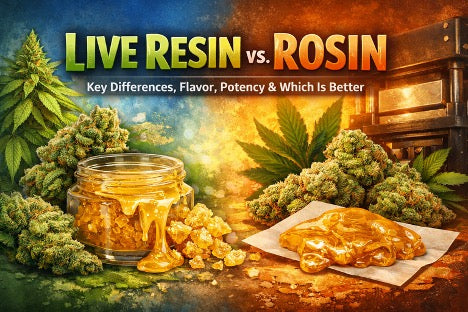
Key Takeaways:
- Live Resin and live Rosin are both popular types of cannabis concentrates
- Live Resin is solvent-based, while live Rosin is solventless
- Extraction method renders live Rosin purer than live Resin
- Purity further depends on the growing conditions and preservation method
- Live Resin offers an intense, fast-acting scent, while live Rosin provides a more complex but subtle aroma
- Live Resin tests for approximately 65 - 90% THC, while live Rosin tests for about 55 - 70%
- THC potency may vary further by phenotype
- Live Resin is wetter and more malleable, while live Rosin is thicker and buttery
- Live Resin can be vaped or dabbed at higher temperatures, while live Rosin excels at lower dabbing temperature
- Live Resin is generally more affordable, while live Rosin fetches higher price tags
For centuries, smoking was the principal way to consume marijuana. However, that changed when fancier formulations like concentrates emerged.
Concentrates provide significant perks over traditional weed delivery methods. Designed primarily for dabbing, these formulations deliver cleaner and healthier vapor.
Switching to concentrates minimizes exposure to toxins in cigarette smoke, including carcinogenic compounds like formaldehyde.
Concentrates also boast a fast onset time, particularly compared to weed edibles. The effects can kick in within minutes, making them ideal for active cannabis users.
And while generally recommended for highly seasoned connoisseurs due to their superior potency, anyone can enjoy concentrates provided they follow expert dosage guidelines.
Live Resin and live Rosin are some of the most popular cannabis concentrates. Both formulations are derived from fresh cannabis flowers, making them remarkably pure and potent.
However, live Resin and live Rosin differ across several parameters. From extraction method to purity, average THC potency, etc., understanding these distinctions can help you pick the better concentrate.
Read below for a comprehensive live Resin vs. live Rosin comparison.
What Is Live Resin Vs. Live Rosin?
Live Resin and live Rosin are cannabis concentrates renowned for their high purity and enhanced flavor profiles. But before unpacking this live Resin vs. Rosin guide, we should perhaps back up and understand what concentrates are all about.
Cannabis concentrates are special weed formulations infused with significantly higher amounts of the plant’s bioactive compounds.
How Are Concentrates Measured?
Marijuana secretes over 100 useful molecules, which fall into three broad categories - cannabinoids, terpenes, and flavonoids.
Most cannabis concentrates are notably higher in cannabinoids and terpenes.
But how do these compounds differ?
About Cannabinoids
Cannabinoids are the molecules in marijuana that have been widely researched for their potential therapeutic properties. They’re more accurately called Exo cannabinoids or Phyto cannabinoids, contrasting them from the body’s own endocannabinoids like anandamide.
Most concentrates have their potencies gauged in terms of their average tetrahydrocannabinol (THC) strength.
THC is marijuana’s predominant mind-altering molecule, which also possesses incredibly therapeutic properties.
Cannabidiol (CBD) is another top cannabinoid in cannabis concentrates. CBD differs fundamentally from THC in that it’s non-psychoactive, making it a staple in medical marijuana products.
Concentrates may also contain the following cannabinoids, albeit in trace amounts:
- Cannabigerol (CBG)
- Cannabichromene (CBC)
- Cannabinol (CBN)
- Cannabidiolic acid (CBDA)
- Tetrahydrocannabinolic acid (THCA)
About Terpenes
Terpenes are naturally occurring herbal compounds responsible for each plant’s signature scent and taste.
Cannabis produces several terpenes, depending on the strain and phenotype.
Here are some dominant ones, alongside their distinct aroma and flavor profiles:
- Myrcene – Herbal or earthy
- Pinene – Woody
- Limonene – Citrusy
- Caryophyllene – Spicy or peppery
- Linalool – Floral
Note that terpenes aren’t merely responsible for concentrates’ primary natural flavors. They also possess certain therapeutic properties, working alongside the cannabinoids in each product to deliver the famous entourage effect.
Studies have shown that Myrcene and Linalool are remarkably calming. Therefore, live Resin or Rosin with high levels of either terpene may foster relaxation.
Pinene and Limonene are mostly energizing, making them excellent for energy metabolism and mood elevation.
Caryophyllene possesses remarkable anti-inflammatory properties. Besides delivering a peppery sensation, this terpene may also soothe inflammation.

Similarities Between Live Resin and Live Rosin
1. Both Are Cannabis-based
Live Resin and Rosin derive from marijuana. Therefore, they both possess the plant’s incredible healing properties.
Common therapeutic applications include:
Pain Management
You can administer live Resin or Rosin for pain relief.
When consumed, the products’ active cannabinoids - notably THC and CBD - alleviate body aches by impacting certain pain-signaling endocannabinoid receptors (like the vanilloid receptor) and endocannabinoids (like anandamide).
Easing Inflammation
Live Resin and Rosin may also soothe inflammation.
Research has found THC, CBD, and CBG to possess exceptional anti-inflammatory properties.
The cannabinoids work synergistically with certain terpenes, particularly caryophyllene, to ease inflamed tissues and joints.
Treating Stress and Insomnia
Most cannabinoids in live Resin and Rosin contain anxiolytic abilities, making them effective against stress and anxiety.
Many findings suggest that THC and CBD induce calmness by stimulating serotonin signaling.
Since anxiety is a leading cause of sleep deprivation, it’s understandable why live Rosin and Rosin may treat insomnia too.
Other common issues you can remedy with live Resin and Rosin include:
- Mood swings
- Chronic fatigue
- Cognitive impairment
- Nausea and inappetence
- Workout-related conditions like DOMS (delayed onset of muscle soreness)
2. Both Derive From Flash-freezing
Flash-freezing is a cannabis preservation technique in which freshly harvested flowers undergo immediate freezing at frigid conditions of around 0 to -40 degrees Fahrenheit (-18 to -40 degrees Celsius).
Flash-freezing helps preserve a flower’s cannabinoids and terpenes. It explains why concentrates, including live Resin and Rosin, deliver enhanced therapeutic effects and intense flavor profiles.
3. Both Deliver Fast-Acting, Long-lasting Benefits
Onset time and longevity of effects are critical considerations while choosing cannabis formulations, particularly for active users.
Most people desire products that get marijuana into their bloodstream instantly. And that’s another area where live Resin and live Rosin stand out.
Due to their dense cannabinoid profiles, Resin and Rosin can deliver effects within minutes.
The bioactive compounds in live Resin and Rosin readily absorb into your bloodstream. And, depending on the doses consumed, effects may linger for hours or days.

Difference Between Live Resin and Rosin
1. Starting Material
Both live Resin and live Rosin involve flash-freezing freshly-cut cannabis buds. That pretty much explains the “live” portion of their names.
However, live Rosin typically requires higher-quality bubble hashing derived from the frozen material. The choice of starting material inherently designates live Rosin as superior to live Resin.
But as you shall find, several other factors will determine how both concentrates turn out.
2. Extraction Method
Both live Resin and live Rosin undergo flash-freezing. However, the subsequent extraction process differs fundamentally.
To obtain live Resin, processors utilize hydrocarbon solvents like butanol and propanol.
Live Rosin uses a solventless extraction process, typically the Supercritical Carbon Dioxide (CO2) Method. Other reagents include heat and water.
3. Potency and Purity
Solvent extraction maximizes cannabis’ yield volume. Resultant products, such as live Resin, are also considerably potent.
However, concentrates obtained by solvent-based methods may contain solvent residues that diminish their purity. The manufacturing process is also high-risk as it involves using flammable reagents.
Solventless extraction methods like Supercritical Carbon Dioxide Extraction yield exceptionally pure concentrates due to the lack of solvent impurities. While this process is labor-intensive, it produces cleaner and premium-grade extracts like live Rosin.
NOTE: Live Rosin may contain non-solvent residues like pesticide molecules. To ensure maximum purity, insist on concentrates obtained from organically-cultivated flowers.
4. Cannabinoid and Terpene Profile
The cannabinoid and terpene profile is the fundamental differentiator between concentrates and standard cannabis extracts. But even within the ranks of concentrates, chemical compositions can still vary significantly.
Live Resin tends to be slightly higher in cannabinoids, while Rosin boasts a superior terpene profile. Since these variances are less pronounced, most people don’t notice them.
You’ll need to be a highly skilled cannabis connoisseur to distinguish between live Resin and live Rosin’s effects.
5. THC Concentration
As noted, tetrahydrocannabinol strength provides the basis for gauging a concentrate’s potency.
For context, most concentrates contain well over 50% THC concentration. That’s significantly higher than standard marijuana extracts, whose THC strength staggers around 15% - 25%.
Live Resin tests for about 65 - 90% THC, while live Rosin has a lower THC level at 55 - 70%. Expectedly, a Resin or Rosin’s actual tetrahydrocannabinol concentration will depend on the origin strain.
Some phenotypes are naturally higher in THC than others. Therefore, you’d expect the resultant concentrate to provide decent THC levels despite the extraction method used.
6. Aroma and Flavor Profile
Cannabis’ aroma and flavor impact each dosing experience.
Fortunately, both live Resin and live Rosin are minimally processed. The concentrates preserve marijuana’s natural scent and taste remarkably well.
However, live Rosin locks in terpenes better than Resin. The concentrate delivers a more natural and balanced aroma/flavor profile.
Live Resin produces a more intense scent and taste. The flavor profile may get a lot more nuanced, particularly for Resins laced with solvent residues.
7. Texture and Consistency
Live Resin and live Rosin are both soft. They’re notably more malleable than popular concentrates like shatter, crumble, and distillates.
But there’s a noticeable distinction in terms of texture flexibility.
Most live Resins are wet and sticky. They may also appear soupy, making them super easy to dose.
Live Rosin has a varied consistency, from thick wax to buttery.
8. Delivery Methods
Concentrates, including live Resin and live Rosin, are typically consumed via dabbing. You can also administer them using standard vaping devices like vape mods.
Other common delivery methods include:
- Twaxing – Applying a concentrate to the interior or exterior of a blunt, pre-roll joints, or bowl of flower
- Ingesting like an edible
- Sublingual delivery – Dripping a concentrate underneath your tongue
- Topical application
While numerous delivery methods exist, each cannabis concentrate excels when administered in specific ways.
Live Resin delivers maximum effects when vaped or dabbed at higher temperatures (above 550 degrees Fahrenheit). In contrast, live Resin favors lower temperatures of 450 - 550 degrees F.
Note that extreme vaping temperature can cause a burnt hit. It may also trigger throat irritation, impacting your vaping experience.
Conversely, low-temperature vaping produces minimal vapors and less intense flavors. This may have you consuming larger amounts of live Resin or Rosin without achieving the intended effects.
The trick is to start slow and increase the temperature gradually until you find your sweet spot.
9. Cost and Availability
Live Rosin results from higher-quality bubble hashing material. Besides, this concentrate requires a more labor-intensive process to make.
Therefore, you’d expect those mark-ups to reflect in the product’s purchase price.
The saving grace is that live Rosin is incredibly pure. And the purity of cannabis extracts impacts their overall effects.
So, while you’d pay more for a similar quantity of live Rosin than Resin, you’re assured of more enhanced therapeutic benefits. The absence of solvent residues further makes Rosin safer to consume at slightly higher doses.
It’s also exciting to know that you can readily prepare live Rosin at home using proper tools and the right know-how. That’s in contrast to live Resin, which requires using highly flammable materials.
Frequently Asked Questions
1. Live Resin vs. Rosin - Which Is Stronger?
Live Resin delivers more enhanced therapeutic effects, while live Rosin excels in flavor preservation.
2. Which concentrate preserves more terpenes?
Rosin preserves terpenes better than Resin.
3. Why is Rosin usually more expensive than live Resin?
Rosin’s complex extraction process renders premium-quality products, which explains their higher price tags.
4. How can live Resin or Rosin be consumed?
You can consume live Resin and Rosin by dabbing and vaping, although the former excels in lower- temperature dabbing.
5. What else impacts Resin and Rosin’s effects?
The origin phenotype, cultivation method, and preservation techniques also impact the effects of live Resin and Rosin.

Live Resin vs. Rosin - Which Is Better
When it comes to choosing the best cannabis formulations, due diligence is critical. Extensive research is particularly significant while selecting between seemingly identical marijuana preparations, such as live Resin and live Rosin.
Remember that both live Resin and Rosin are remarkably potent.
Each concentrate contains over 50% THC, enabling it to provide more enhanced effects than standard cannabis extracts. They’re also fast-acting and deliver therapeutic benefits within minutes.
And, for those wary of the adverse effects of smoking traditional cannabis pre-rolls, live Resin and Rosin provide a safer alternative. But that’s where the similarity ends.
Live Resin and live Rosin vary in nearly every other way. Key differentiators include extraction method, texture and consistency, average purity levels, and THC composition.
We hope you can leverage this live Rosin vs live Resin comparison to select the better concentrate for you.
Choose live Resin for its intense flavor profile and live Rosin for its superior purity. Either way, moderate your serving portions to avert severe adverse events.
Note that both live Resin and Rosin are significantly high in THC. An overdose can trigger a slew of negative reactions, including hallucinations and mental impairment.


