

Key Takeaways:
- Cannabis concentrates are enhanced forms of marijuana extracts.
- Concentrates differ primarily in their THC potencies.
- While THC tends to be the dominant compound, a concentrate may feature other cannabinoids like CBD and THCa.
- Concentrates deliver cannabinoids more readily into your system.
- Flavors are cleaner and more intense.
- Extraction method impacts a concentrate’s purity and potency, and so do dosages.
- Concentrates may alleviate several ailments.
- Full-spectrum concentrates are desirable for their nuanced therapeutic effects.
- Concentrates come in varied formulations.
Cannabis concentrates have piqued the interest of marijuana users worldwide, thanks to their high-potency, fast-acting benefits. A single dose can provide lingering therapeutic effects, making them excellent for managing chronic conditions.
But concentrates aren’t made equal, either. The products differ across several parameters, including extraction method, consistency, THC potency, and overall cannabinoid profile.
Understanding these distinctions is critical before shopping for weed concentrates.
Fortunately for you, we’ve prepared a comprehensive cannabis concentrates guide to help you find the right product based on your needs and expectations.
Weed Concentrates Explained
If you’ve been scouting for high-potency cannabis extracts, you’ve probably stumbled upon several publications recommending concentrates.
But what are cannabis concentrates?
Well, the name pretty much gives it away. Cannabis concentrates are essentially marijuana formulations infused with higher concentrations of the plant’s bioactive compounds.
Most concentrates are gauged by their THC content. Short for tetrahydrocannabinol, THC is marijuana’s most potent psychoactive chemical.
Studies have found THC to be therapeutically beneficial, too. Common pharmacological applications include pain management, stress relief, fatigue treatment, and appetite stimulation.
Besides THC, cannabis concentrates are significantly rich in other cannabinoids and terpenes. Those include cannabidiol (CBD), cannabigerol (CBG), tetrahydrocannabinolic acid (THCa), myrcene, beta-caryophyllene, etc.
How to Prepare Concentrates
Concentrates can be solvent-based or solventless.
Solvent-based concentrates are prepared using solvents, particularly hydrocarbons.
Although relatively cheaper, this method involves using highly flammable hydrocarbons. Besides, the resultant products may contain solvent residues as impurities.
Solventless concentrates mostly result from Supercritical Carbon Dioxide (CO2) Extraction.
CO2 extraction is safer since it uses carbon dioxide gas, a non-combustible agent. The absence of solvent residues also renders the final products purer and more potent.

Why Choose Cannabis Concentrates?
Cannabis concentrates provide fast-acting benefits.
Dose for dose, concentrates deliver more bioactive compounds into your system than standard cannabis formulations. You can feel the effects within minutes.
But that’s not all.
Concentrates provide long-lasting benefits too. A single dosage can linger in your bloodstream for days, making these formulations ideal for managing chronic conditions.
Other noteworthy benefits of weed concentrates include:
1. Entourage Effects
Concentrates provide decent servings of marijuana’s bioactive compounds, including cannabinoids, terpenes, and flavonoids. When consumed, these substances work synergistically to provide greater therapeutic benefits via a process called the entourage effect.
The entourage effect is particularly more pronounced where tetrahydrocannabinol and cannabidiol are involved.
THC causes a cerebral rush, leading to heightened sensory awareness.
CBD is non-psychoactive. It’s mostly administered medicinally, helping with common ailments like pain, anxiety, and insomnia.
Not only do the two compounds deliver enhanced therapeutic benefits. Studies have shown that cannabidiol may also modulate tetrahydrocannabinol’s psychoactive high, minimizing THC-induced impairment.
2. Superior Flavor Profile
Most concentrates are minimally processed. Therefore, they carry marijuana’s natural flavors. Each cannabis strain has a distinct scent and taste, depending on its dominant terpenes.
For instance, myrcene is generally herbal, while beta-caryophyllene is peppery. Limonene is citrusy, pinene is woody, and linalool has lavender-like aromas.
Concentrates preserve terpenes incredibly well, resulting in superior flavors.
3. Varied Delivery Methods
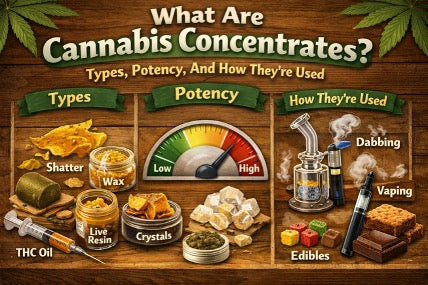
Dabbing is one of the most common ways to administer cannabis concentrates.
Dabbing is a special form of vaping, in which you use a torch to heat a dab nail attached to a dab rig to flash-vaporize a concentrate. You then let the vapor cool before inhaling.
Other popular ways to consume cannabis concentrates include:
- Regular vaping using e-liquid cartridges
- Twaxing – Adding concentrates onto the inside or outside of a blunt, pre-roll joint, or bowl of flower
- Ingesting
- Sublingual administration
- Topical application
Types of Cannabis Concentrates

1. Shatter
THC Content: 70 - 90%
Shatter is a brittle, glass-textured type of cannabis concentrate formulated primarily for dabbing using a dab rig or nectar collector.
The product is typically translucent. However, it may also appear in varying shades of yellow, from light to golden.
Shatter comes in diverse consistencies, too. You can choose from soft, sticky formulations or highly brittle options.
Despite its high THC content, shatter readily breaks into smaller pieces for controlled dosing. Use a dabber to carefully split off a portion based on your ideal cannabis dosage.
2. Crumble
THC Content: 60 - 90%
Crumble is a dry, brittle cannabis concentrate with a honeycomb-like texture. It’s a solvent-based concentrate commonly extracted using butane hash oil (BHO).
To prepare crumble, you first add measured amounts of BHO to a cannabis flower. The mixture then undergoes low heating.
Once BHO has stripped cannabis buds of all their cannabinoids and terpenes, you vacuum-purge to remove the plant material. This leaves behind a highly potent, intensely aromatic yellow-to-brown substance.
Crumble is considerably easier to handle than shatter. It’s also remarkably versatile, with its crumbly texture making it ideal for twaxing or vaping.
3. Budder
THC Content: 60 - 80%
Budder is a soft, creamy concentrate testing for up to 80% tetrahydrocannabinol.
More commonly known as wax, budder stands out for its pliability. Its soft texture allows you to scoop it with ease for dabbing or adding to pre-rolls.
Budder is relatively easier to prepare than many cannabis concentrates. For most users, the real challenge is maintaining its consistency.
Implement the ideal storage conditions to prevent your cannabis wax from melting or hardening, either of which will impact its flavor. The softer consistency also requires proper handling to avoid smudging and contamination.
4. Badder
THC Content: 60 - 90%
Not to be confused with budder, badder is a distinct cannabis concentrate with a cake or batter-like appearance.
It’s one of the high THC cannabis concentrates to consider, testing up to 90% depending on the extraction method.
Badder and budder differ principally in their consistencies. While budder is waxier and more pliable, badder is typically stickier.
Badder also provides higher THC potency, especially if professionally prepared and properly stored.
5. Live Resin
THC Content: 65 - 90%
Many cannabis concentrates are made from dried or cured buds. However, live resin is a welcome exception.
Live resin derives from flash-frozen cannabis flowers. As the starting material is fresh rather than dried, the resultant product can be remarkably high in THC and other useful cannabinoids.
Live resin also preserves cannabis terpenes remarkably well, making it excellent for flavor chasers.
Texture-wise, live resin is considerably malleable. Most formulations appear grainy, with smooth and saucy options also available.
6. Rosin
THC Content: 55 - 70%
Rosin is a sticky, solventless cannabis concentrate with an average THC potency of 55 - 70%. The product is prepared with a rosin press, which involves applying heat and pressure to cannabis plant material.
Rosin is a purer alternative to many solvent-based concentrates. By using heat and pressure, manufacturers effectively rid the resultant product of solvent residues.
Rosin may be traditional or live.
Standard rosin uses dried cannabis buds, while live rosin derives from live cannabis flowers. The latter delivers a more intense flavor profile and balanced effects.

7. Kief
THC Content: 50 - 80%
Cannabis kief refers to raw, powdery trichomes obtained from harvested cannabis flowers.
To make kief, you require a multiple-chamber grinder. Prioritize the trichomes that collect on the lower chambers due to their smoother consistency.
Kief is typically ready to consume after grinding. However, you can also use it as a raw material for other concentrates, such as rosin and hash.
Kief is remarkably versatile, too.
Add the substance to a pre-roll joint and enjoy fast-acting benefits. Or, sprinkle it over your dessert for a more discreet experience.
8. Hash
THC Content: 50 - 80%
Hashish or hash is a traditional form of cannabis concentrate prepared by compressing trichomes into slabs. As noted, it’s one of the results of refining kief.
There are two ways to prepare hashish - hand rubbing and dry sifting.
Hand-rubbing is a more traditional method, which involves rubbing dried cannabis buds manually to collect their resins. Dry sifting requires a bit of a learning curve, although it results in more potent products.
Hash is relatively easy to consume. You can use a regular vaporizer, a traditional joint, or a more specialized hash pipe.
9. Distillate
THC Content: 60 - 90+%
Distillates are arguably the most potent cannabis concentrate. They can test for 90+ THC, making them almost a preserve of seasoned users.
To prepare distillates, processors usually strip the starting material of every other compound but the target cannabinoid. This renders the final product odorless and tasteless.
After preparation, some manufacturers may reintroduce terpenes to enhance their products’ flavors. Carefully read the ingredients list for insights into a distillate’s chemical composition before purchasing it.
Due to their higher THC potency, distillates may last longer in your system than other cannabis concentrates. Consider the estimated longevity of effects before administering these products.
10. Sugar

THC Content: 60 - 90%
Sugar is a cannabis concentrate with a granular texture that resembles wet sugar.
It’s also called sugar wax or live resin sugar, a nod to its consistency and purity.
Sugar is remarkably high in THC, usually rivaling distillates. This concentrate preserves terpenes quite well, which explains its deeply serenading aroma.
While commonly used for dabbing, sugar wax is equally vapable. You can even consume the substance orally by dissolving it into warm beverages or adding it to dough.
11. Terp Sauce
THC Content: 60 - 90%
Terp sauce may not be the most popular cannabis concentrate. But it provides one of the most potent formulations, with THC content similar to sugar.
To create terp sauce, processors utilize a process called nucleation or diamond mining.
Nucleation entails naturally separating cannabinoids and terpenes into super-aromatic, crystallized forms. This results in a hearty blend of cannabinoid diamonds and liquid terpenes.
Best Cannabis Cultivars For Concentrates
Cannabis exists in different cultivars, including hemp and traditional marijuana.
Hemp is a legal term for cannabis plants containing less than 0.3% of Delta-9.
Delta-9 is THC’s most popular isomer. It’s also remarkably potent, typically over twice as effective as other THC analogs like Delta-8 and Delta-10.
It’s also worth noting that cannabis’s legal landscape is constantly shifting. While earlier legislation generally focused on CBD and THC, regulators are now shifting the spotlight to other lesser-known cannabinoids like Delta-8 THC and THCa.
Research local cannabis laws extensively before buying or publicly using cannabis concentrates.
Concentrates and the Art of Mindful Dosing
Cannabis concentrates are remarkably more potent than standard weed formulations. Therefore, moderation is paramount while administering these products.
First, define your cannabis tolerance level before integrating concentrates into your lifestyle.
Remember that these formulations are ideal for seasoned cannabis users. If you’re a newbie, exercise due caution to avoid undesired effects.
Start with lower-potency concentrates. While distillates may look appealing with up to 90% THC by weight, you’re probably safer with rosin at 55 - 70% THC.
Despite your preferred concentrate, consume the product sparingly.
Begin with the lowest serving portions - microdoses if possible. 1 - 3 mg is the consensus entry-level cannabis dosage, although this may vary based on the desired effects.
Monitor for unpleasant reactions for up to 12 hours before possibly dosing up.
Be sure to also research the ingredients in a cannabis concentrate before buying it.
Don’t just focus on a product’s cannabinoid composition. Establish if it also contains potentially harmful chemicals, such as pesticide residues and heavy metals.
Frequently Asked Questions
1. What are cannabis concentrates?
Cannabis concentrates are marijuana formulations containing higher potencies of specific cannabinoids, notably THC.
2. Why are cannabis concentrates stronger than regular cannabis?
Most concentrates deliver over 50% THC into your system, making them stronger than regular cannabis flowers, which typically test for 15 - 25% THC.
3. How are cannabis concentrates made?
Cannabis concentrates may be extracted using solvent-based or solvent-free methods.
4. How are cannabis concentrates used?
You can administer concentrates in diverse ways, including dabbing, vaping, twaxing, and smoking.
5. What are the most popular types of cannabis concentrates?
Some popular cannabis concentrates include shatter, crumble, budder, kief, and live resin.
6. What is the difference between wax, shatter, and live resin?
A wax vs shatter vs live resin comparison is mostly based on consistency and extraction method. Wax is more pliable, shatter is highly brittle, while live resin derives from flash-frozen cannabis buds.
7. Are cannabis concentrates safe for beginners?
Since concentrates contain higher THC potencies per serving, beginners should tread cautiously while administering these products.


